
Why Coordinate Different Trades When One Partner Can Help Manage the Entire Solar, Roofing and Electrical Scope?
New construction projects already require general contractors to coordinate dozens of moving parts.
Adding separate contractors for solar, battery storage, roofing, and electrical work can make that coordination even more complicated.
Each contractor has their own plans, schedules, equipment requirements, site needs, and installation timelines. When those scopes overlap, small communication gaps can quickly turn into field issues, change orders, or delays.
For Bay Area general contractors, developers, architects, and builders, working with one company can simplify the process.
It can coordinate multiple scopes of work.
At Infinium Solar, Roofing and Electric, our in-house teams provide solar, battery storage, roofing, and electrical services under one coordinated operation.
Instead of managing four separate trades, project teams can work with one partner from design through installation.
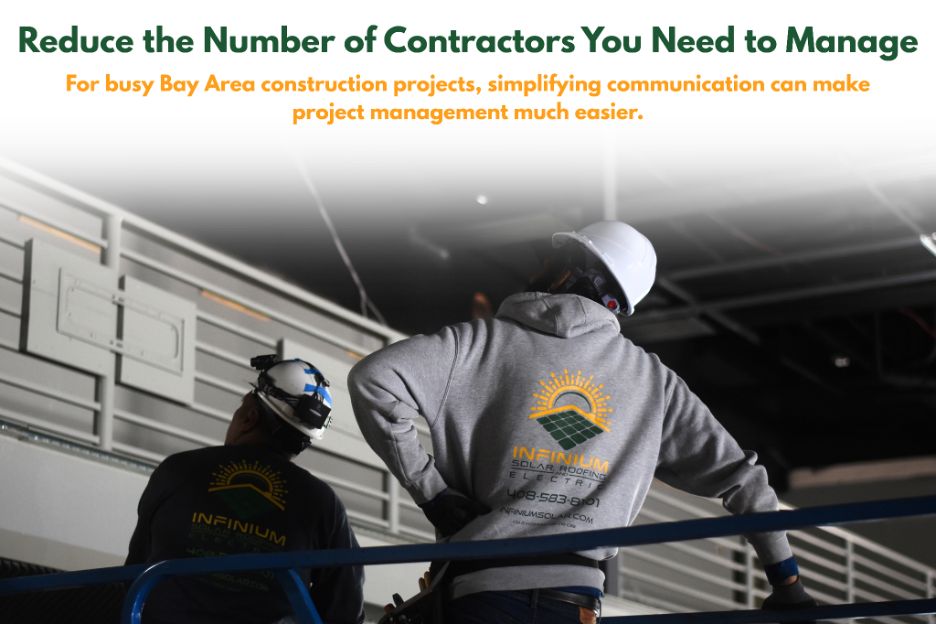
Reduce the Number of Contractors You Need to Manage
Every additional subcontractor or vendor adds another relationship that the general contractor has to coordinate.
That means more:
- Meetings
- Scheduling
- Plan reviews
- Site coordination
- Emails and phone calls
- Scope clarification
- Inspections
- Potential scheduling conflicts
When one partner handles solar, battery, roofing, and electrical work, the GC manages fewer teams.
For busy Bay Area construction projects, simplifying communication can make project management much easier.
Better Coordination Between Roofing, Solar and Electrical
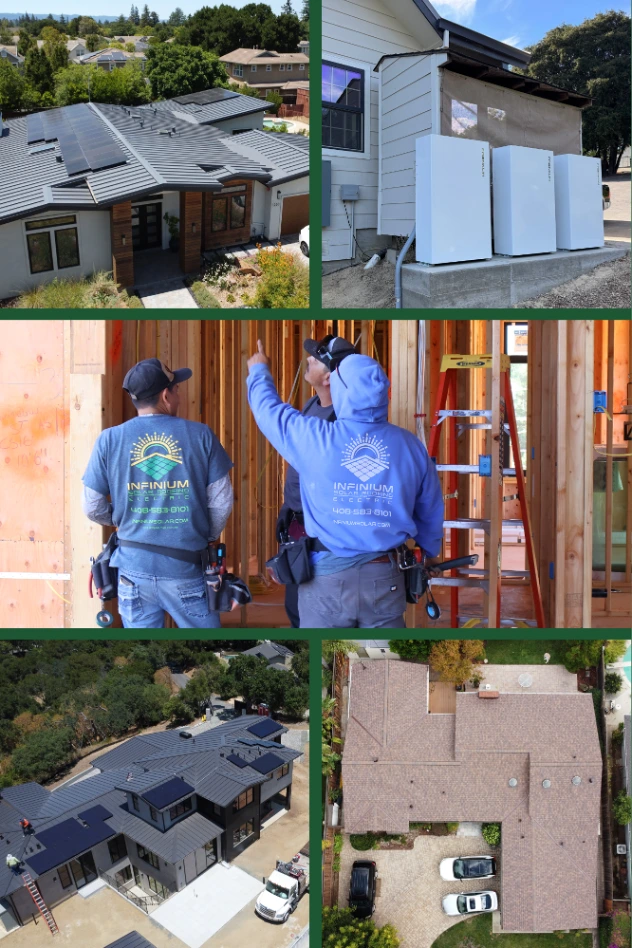
Solar does not operate independently from the rest of the building.
The PV system interacts directly with both the roof and the electrical infrastructure.
Solar attachments affect roofing assemblies. Conduit pathways need to connect rooftop equipment with electrical equipment. Battery systems require appropriate electrical connections and installation locations.
When these scopes are handled by separate contractors, coordination becomes especially important.
For example, the roofing contractor may install something that limits the solar layout. The electrician may place equipment in a location that creates a longer or more complicated conduit route. Mechanical equipment could occupy valuable rooftop space intended for solar panels.
Working with one coordinated team allows these decisions to be reviewed together.
Identify Scope Conflicts Before They Become Field Problems
Many construction issues are easier and less expensive to solve on a drawing than on the jobsite.
Early coordination between solar, roofing, battery, and electrical teams can help identify conflicts such as:
- Solar panels conflicting with rooftop equipment
- Roof penetrations affecting PV placement
- Insufficient wall space for batteries
- Inverter locations conflicting with other equipment
- Electrical panels being positioned far from the solar system
- Conduit pathways becoming difficult after walls are closed
- Roof areas becoming unavailable for solar production
- Service equipment not accounting for future electrical loads
Identifying these issues during design or preconstruction gives the project team more options.
Waiting until installation begins can limit those options.
One Point of Contact From Design Through Installation
Communication becomes easier when the general contractor knows who to call.
A coordinated solar, roofing, battery, and electrical partner can provide one steady contact during the project.
That can include coordination during:
Design and Preconstruction
Reviewing plans, roof layouts, equipment locations, electrical requirements, and potential installation challenges.
Permitting and Engineering
Coordinating solar and electrical plans with the broader construction schedule.
Construction
Working with the GC and other trades to sequence roofing, electrical, battery, and solar work.
Installation and Closeout
Completing installation, testing equipment, coordinating inspections, and preparing the system for operation.
Instead of tracking down several different companies, project teams have a clearer path for communication.
Minimize Finger-Pointing Between Trades
One of the most frustrating situations on a construction site is when something goes wrong.
Multiple contractors may then disagree about who is responsible.
- Is the issue with the roof?
- The solar attachment?
- The conduit?
- The electrical work?
- The battery equipment?
When several contractors are involved, resolving these questions can take time.
A company that understands and coordinates multiple interconnected scopes can help reduce these gray areas.
Rather than focusing only on one portion of the project, the team can look at how the systems work together.
That creates greater accountability and can help resolve issues faster.
Simplify Solar and Battery Integration
Battery storage is becoming increasingly common in California construction.
But adding batteries introduces another layer of coordination.
Battery systems may require dedicated wall space, protection, clearances, electrical equipment, gateways, load management, and specific installation locations.
Solar, battery storage, and electrical design should therefore be considered together.
When one team understands all three systems, they can plan equipment locations and electrical connections.
This becomes part of one larger energy strategy.
This is especially valuable for projects preparing for
- Battery backup
- EV charging
- Heat pumps
- Electric water heating
- Smart electrical panels
- Additional electrical loads
- Future solar expansion
Coordinate the Roof With the Solar System
The roof and solar array will need to coexist for decades.
That makes coordination between the roofing and solar teams especially important.
- Roof layout and roofing materials can affect the final solar installation.
- Roof openings and flashing can also affect it.
- Attachment points, drainage, and roof access can affect it too.
- Equipment placement can affect it as well.
When the roofing and solar work are planned together, the team can plan ahead. They avoid adding the solar system after the roof is finished.
For new construction, that can result in a cleaner and more practical installation.
A Better Approach for Bay Area General Contractors
Bay Area construction projects can already involve complex schedules, permitting requirements, inspections, and coordination between multiple trades.
General contractors do not necessarily need another four vendors to manage.
Working with one partner for solar, battery storage, roofing, and electrical can help streamline communication and reduce unnecessary coordination.
At Infinium Solar, Roofing and Electric, our teams work together across these areas. We help general contractors, architects, developers, and property owners manage energy and electrical systems.
This support is part of the larger construction project.
One Partner. Multiple Scopes.
The sooner these systems are coordinated, the easier it is to find conflicts.
- It also helps plan the installation.
- This keeps the project moving forward.
- Instead of coordinating separate solar, roofing, battery, and electrical companies, consider bringing the scopes together.
Why coordinate four different trades when one partner can help manage the entire energy and electrical scope?
Planning a Bay Area Construction Project?
Infinium Solar, Roofing and Electric can help coordinate solar, battery storage, roofing, and electrical work from design through installation.
Bring us into the project early. We can review plans and spot conflicts. We can coordinate equipment. We can also help simplify the energy and electrical scope.
Talk with Infinium about your upcoming project.